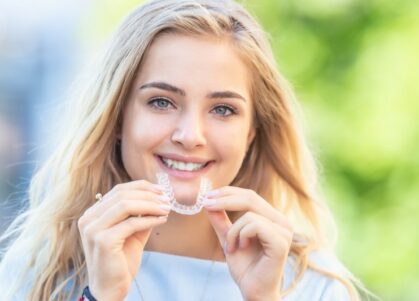
How Invisalign Process Works
Digital 3D Scanning – No Messy Impressions
Your Invisalign journey begins with a digital scan of your teeth.
In most cases, this replaces traditional putty impressions.
- A handheld scanner captures thousands of images per second.
- These are combined to create a precise 3D model of your teeth and bite.
- Your orthodontist can rotate, zoom and inspect your teeth from every angle on screen.
- This digital starting point allows more accurate planning, easier communication and a more comfortable experience for both adults and teens.
Smart Software & Predictive Treatment Planning
Once your scan is complete, specialist Invisalign software is used to plan every step of your tooth movement.
- Each individual tooth movement is carefully staged in small, controlled steps.
- Your orthodontist can simulate different treatment options and choose the most efficient path.
- A digital “before and after” style simulation shows how your smile is expected to change over time.
Behind the scenes, Invisalign’s planning tools draw on a huge bank of previous cases. This helps improve predictability and allows your orthodontist to design a treatment that is tailored to your teeth, age and lifestyle.
3D Printed, Custom-Made Aligners
Your aligners are then manufactured using advanced 3D printing and thermoforming technology:
- Each aligner is custom made to fit your teeth at a specific stage in the treatment.
- Microscopic adjustments are built into each aligner to apply gentle, consistent forces.
- The result is a series of clear trays that guide your teeth into a better position over time.
Because everything is digitally mapped in advance, you typically receive several sets of aligners at once, making treatment more convenient for busy adults and teens with school, exams, sport or social activities.
Advanced SmartTrack Material
Invisalign aligners are made from a specially engineered plastic (known as SmartTrack material):
- Designed to be strong yet flexible for controlled tooth movement.
- Fits snugly around the teeth for better grip and comfort.
- Helps deliver more consistent forces compared with many generic clear aligners.
For adults, this means a treatment that is usually easier to wear throughout long working days.
For teenagers, it helps aligners stay in place even during talking, laughing and day-to-day life.
SmartForce Attachments & Precision Features
In some cases, small tooth-coloured “attachments” are placed on certain teeth:
- These are carefully shaped and positioned to give the aligners something to gently push against.
- They help with more complex movements such as rotations, root control or vertical changes.
For teens who may have more challenging bite issues, additional precision features can be used:
- Bite correction features for certain overbites.
- Space management to allow for erupting teeth in growing mouths.
These features mean many cases that once needed fixed braces can now be treated with clear aligners instead, depending on clinical suitability.
Continuous Monitoring & Adjustments
Because your treatment is digitally mapped, your orthodontist can:
- Review your progress at regular check-ups.
- Adjust your treatment plan if your teeth move faster or slower than expected.
- In some practices, use remote monitoring tools and photo check-ins to reduce the number of in-person visits you need.
Adults often value fewer appointments around work and family life, while teens benefit from shorter, more focused visits around school and activities.
Why Invisalign Technology Works Well for Adults
For adults, Invisalign technology offers:
- Discreet treatment – clear aligners are hardly noticeable in most day-to-day situations.
- Flexibility – aligners can be removed briefly for important meetings, social events, eating and brushing.
- Predictable planning – digital simulations help you understand your likely outcome before you start.
This combination makes Invisalign a popular choice for professionals and busy parents who want a straighter smile without the look of traditional braces.